Frequently Asked Questions - Home Types and Pricing
Aren’t apartment buildings (or condominiums) more economical to construct and operate?
In general, this is a myth. With pre-fabrication and mass production, it is hard to beat the efficiency of dropping several small homes on a cluster of foundations. With solar power, they can be highly efficient to heat, and they need minimal cooling because they have superior ventilation. There is no wasted (common) space, no quarrels about different preferences for maintenance. Their mortgages can cost less.
Small multi-family buildings (up to six units) are also efficient. Construction wise, they cost slightly less than single pre-fabs. When one considers condo fees, rental overhead and profit, and higher cooling costs, and typically less volunteer maintenance time, these buildings cost more to maintain.
Above six-family buildings, costs increase significantly as one adds common space, elevators, concrete/steel construction, commercial fire suppression, janitorial space and services, and other professional maintenance. All this contributes to a typical size of 1,000 sf/unit even if only 600 sf is rented. A 47-unit in South Burlington cost $345/sf three years ago. Costs for subsidized housing can run as high as $500/sf.
It seems that a tiny house costs about twice as much as a regular sized house on a $/square foot basis. Why are tiny homes seen as an affordable alternative?
Most homebuyers have an absolute budget ceiling, the price they can be pre-qualified for at a bank. It is true that tiny homes cost more per square foot – for instance, most homes have just one kitchen, whatever their size -- but the total product hits the target sales price.
Our small home sizes reflect economic reality but also reflect how people live now: efficient, sustainable, and convenient.
With variety may come increased cost. It would seem less costly to put up one or two big buildings. I like the variety imposed but what is cost difference in that approach.
Within reason, a variety of pre-fabs is less expensive than a couple big buildings. (See the answer above.) Very roughly, we believe our variety of small dwellings is about half the cost of big buildings.
Will I be able to get a mortgage on a small house?
The short answer is YES. Several local banks, but particularly EastRise and North Country, support the small home trend. They are willing to loan on houses meet HUD standards down to 300 sf. Mortgageable homes do not even need to have a bedroom. The primary challenge now is getting a conventional mortgage, which lets a buyer pay less up front and can have lower interest rates. Two factors are comparables – getting enough housing stock in our area so that an appraiser can find three comparables for the appraisal – and also type of ownership. Condominiums, particularly in unfinished developments, can have challenges. We are working on both of these issues. In the meantime, banks like EastRise and North Country can offer portfolio mortgages.
What percentage of rentals versus owned homes do you propose?
Our model does not fix the proportion of rental versus ownership because it is market based. We intend to offer 75% of the units for sale. If homes do not sell at the pace required to meet CHIP requirements, Execusuite will build and rent (or rent-to-own). After the project is completed, Execusuite can sell or keep renting those units.
We look forward to working with the City and others to shape targets for ownership and rentals. One tool is deed restrictions. For instance, we can require that units be primary residences for the length of the CHIP bond. We can prioritize types of buyers within legal limits.
It also seems like the architect that they are using is proposing mostly tiny homes. I'm not sure that there is sufficient demand to have a development of mostly tiny homes. Is this an accurate assumption?
In response to public feedback, we have reduced our current number of “tiny homes” (studio or no bedroom) to 3 rented studio apartments (Downstreet) and 3 owned tiny homes. It’s important to remember that the number of owned tiny homes is very flexible, up to the time a block is built out.
Why didn't they include any apartments in their proposal? How did they arrive at the number of units in their proposal?
We do have apartments in our current mix, at minimum 63 units (20% of the whole project).
You are proposing to sell tiny homes to households with incomes under 30% of median yet those households are generally not good candidates for homeownership because they are too stressed financially.
The least expensive tiny home we are using is about $155,000. That is appropriate for a 1- or 2-person family with an income of $47,000-$54,000 per year, about 60% Montpelier’s median income. We would love to get our price lower – and there are plenty of reliable, hard-working people in Montpelier who earn less and would like the security of an owned home – but we can’t do that without owner’s labor or more plastics in the construction. Those solutions are unfortunately not compatible with other aspects of the project. If we can find compatible ways to sell homes for less than $155,000, we certainly will.
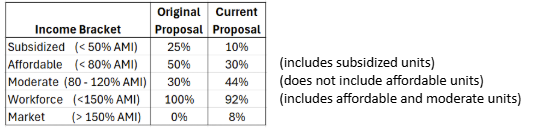
What percentage of affordable homes do you propose?
A chart seems like the clearest way to answer this question. It compares our originally proposed percentages with our current proposal. The shift is based on public feedback to date.
This mix will continue to evolve as we finalize the project financing and market study.
What data have you used to develop your unit mix?
We relied heavily on the CVRPC Housing Needs Assessment. Our analysis “Housing Methodology” is in the “Documents” tab on our website.
What is your interest in creating affordable homes for local citizens?
That is our primary focus with this whole project, mostly owned (with or without shared equity) and some rented.
Are there ways to increase the number of market rate units?
YES, and your feedback is helpful!
The City should champion the development of diverse housing types, density, and price points as part of any selected proposal.
Agreed!
How is affordability maintained long-term?
In the case of the single family homes being developed, what safeguards can you put in place to ensure that they will be occupied as primary residences instead of as short-term rentals or second homes?
For units sold as affordable, the CHIP program requires a 20-year (or life of the bond) deed restriction both for income and for the residence being used as a primary residence. For Downstreet’s rented and shared equity units, they are restricted perpetually. Habitat for Humanity’s units are also perpetually restricted. At this time we don’t propose any other restrictions, but we are open to City recommendations.
Aren’t apartments a safer option for keeping homes affordable perpetually?
As described above, both apartments and homes can be perpetually restricted for affordability. It’s worth questioning the desirability of making all new development perpetually affordable. This would have a significant impact on Montpelier’s tax base, and it would have a significant impact on the desirability of Country Club for long-term ownership. Owning a home and accruing equity in that home is sometimes the only tool a family has to grow wealth. Owned homes are one of the few assets immune to Medicare. A number of Montpelier residents have expressed interest in owning rather than renting a home.
Several respondents (self-identified seniors in their 70s) emphasize the need for single-level, no-step-entry homes with wide doorways and elevators in multi-story buildings. They describe having no viable downsizing options in Montpelier currently. Universal design principles are urged as a condition of the award.
Agreed! We hope to accomplish this with minimal elevators in the project.
Unintended but real difference between "poor" and "rich"? These groups separated by large open fields? Will they communicate?
This an important criterion for the final site design. We welcome your help to get this right.
While I support the vision, the reliance on pre-fabricated construction must be executed with Vermont's climate in mind. My concern is that lower-quality modular envelopes can lead to thermal bridging and thaw-refreeze cycles.
Are you concerned about the quality of the housing that would be provided by Fecteau homes?
All of our buildings will meet or exceed Vermont building standards. We decided not to include manufactured housing in this project, but they are increasingly energy efficient as well. Some Fecteau models are Energy Star rated.
What would the planned re-sale value be for each unit type?
The same as any other building in central Vermont. Our homes will hold value like stick-built construction; they are not built on a chassis (manufactured housing).
I'm concerned the stated pricing on the homes may change to become less affordable in time because the cost of everything seems to increase continually.
We are going to do our very best to hold pricing steady. We can’t control factors like the US-Iran war, but we are already working on how to reduce costs in the house/apartment models we have shared so far.
What is your research telling you with regard to innovative programs (local, national, international) to help individuals live in affordable housing?
Our research says American citizens are used to very large homes compared to the rest of the world, on very large lots:

Comparison of lot sizes are even more outstanding. Vermont has the largest average lot size in the country at 78,408 sf (about 1.8 acres). A common lot size after 1945 in Montpelier, for example, was 10,890 sf (1/4 acre). Compare this with typical rowhouse lot sizes on the East Coast: In Washington DC, the median lot size for a rowhouse is 1,633 sf, and 90% of rowhouses are built on lots that are smaller than 2,700 sf. One great article on this subject is "The Great Compression" (Dougherty, 2024), also in our “Documents” tab.
Phasing of building this? Would 2/3 bedroom single family homes be available in initial phases?
It’s difficult to pin down phasing for infrastructure: it’s a function of interest rates. It’s our goal to offer as many types of homes as possible throughout the project to maximize absorption (the speed at which the project is occupied), but it does not make sense to have installed pipes and roads sitting idle when carrying costs are high. To answer the specific question, YES 2 and 3 bedroom homes will be available in the initial phase; what we cannot promise is building type. For sure we will have rowhouses and duplexes (completely owned but attached) in the initial phase; hopefully we will be able to offer 2-3 BR cottages and stand-alone homes early as well.
How much a month would a studio rent for?
We cannot speak for Downstreet. If Execusuite ends up building and renting some tiny homes, their rent would be the equivalent of a purchased $155,000 home, so very roughly $1,200/month according to the current VHFA’s affordability chart.
Would you look into other suppliers of pre-fabricated housing in addition to Huntington Homes?
Ideally Country Club will be a showcase for all of Vermont’s suppliers of pre-fabricated homes (both modular and panelized). We have been working from the beginning with Brushwood, Foam Laminates of Vermont, New Frameworks, Sweet Dreams Microhomes, Timberhomes, and UpEndThis. All are eager to contribute homes at Country Club.
Does your plan include the possible sale of lots for single-family homes of the owners' own design?
YES! Stick-built will be a lot easier where lots are bigger. Our chief concern is guaranteeing occupancy by certain dates for the CHIP bond’s paydown.
Would individuals have a say in tiny home or cottage designs?
To the degree that they are affordable, they need to be standardized. There will probably be very few choices. To the degree that a buyer has budget to customize, most of our suppliers can customize.
I would like to know more about planned accessibility. For example, how many units will be wheelchair accessible?
It’s a high priority to make the project accessible, and we look forward to working with the Vermont Council for Independent Living plus interested residents to accomplish this goal. Right now we anticipate 18 rentals and 64 condos or cottages being accessible, for a total 72 homes (24%) of the project, all being ground floor level (no elevators). This number will certainly change, but it seems like a good start.
How will you address housing for people with intellectual and developmental disabilities? This is a critical community need.
This project aims to be diverse and inclusive, and we look forward to working with DD providers such as Upper Valley Services. Our subsidized units will need to be limited by tax increment requirements.
What is the experience of the architect in designing large multi-family buildings?
Downstreet is a self-contained project, and they will hire their architect and contractor by bid. The rest of our units are small multi-family or mixed use. Some of these will be designed by pre-fab suppliers like Huntington Home, and some will be designed by Sandy Vitzthum. Sandy has 30 years’ experience designing residential and small commercial buildings.
Could it be more desirable to have smaller clusters of the smallest homes (in rental areas and in owned areas), instead of grouping them all together in each of those areas?
This is a great idea, and we look forward to working with prospective buyers to sort this out. Downstreet will have their own process.
Will you consider less efficiencies and getting a commitment from Downstreet to be involved?
YES about fewer efficiencies – see above – and we have a tentative agreement with Downstreet already. Next step with them requires land control.
How is income bracket calculated? How do I find mine?
This chart is updated regularly by the Vermont Housing Finance Agency. It’s used for calculating loans and grants/subsidies. Washington County is included in the general Vermont chart. (Chittenden and Addison Counties have higher numbers.)
How can a rowhouse be simply owned?
“FEE SIMPLE” is the term to describe an outright-owned home.
In a zoning district with zero side-yard setbacks, a house can extend right to the property line, which can be a shared, fire-rated wall. This is common in cities like Boston, Baltimore, and New York.
We will have some kind of homeowners’ association for the village, and for each cottage cluster, but these will be related to the land the home sits on, not the building itself.
How long will it take you to build out your project?
We have targeted a very broad range of buyers, and this should mean that we can fill houses more quickly than if we only have 4-5 kinds of homes. Moreover, we intend to bring infrastructure to all areas initially so that all those house types can be sold from the beginning. We project we should be able to complete all buildings within three years after starting construction. Of course this is subject to market conditions.
Can there be a lot of one-story homes? Can we create a nursing service to let us age in place?
YES! We are limited only by our imagination. One person has a suggested that one small 2-story house have a health clinic on the first floor, and a small suite upstairs so a nurse can be in the village 24/7, rotating on 8 hour shifts. Another group discussed buying a whole cottage cluster and giving over one house to a community building with large dining, hobby space, and guest quarters.
Can there be a rent-to-own program?
This was a great suggestion. We have already started looking into this.